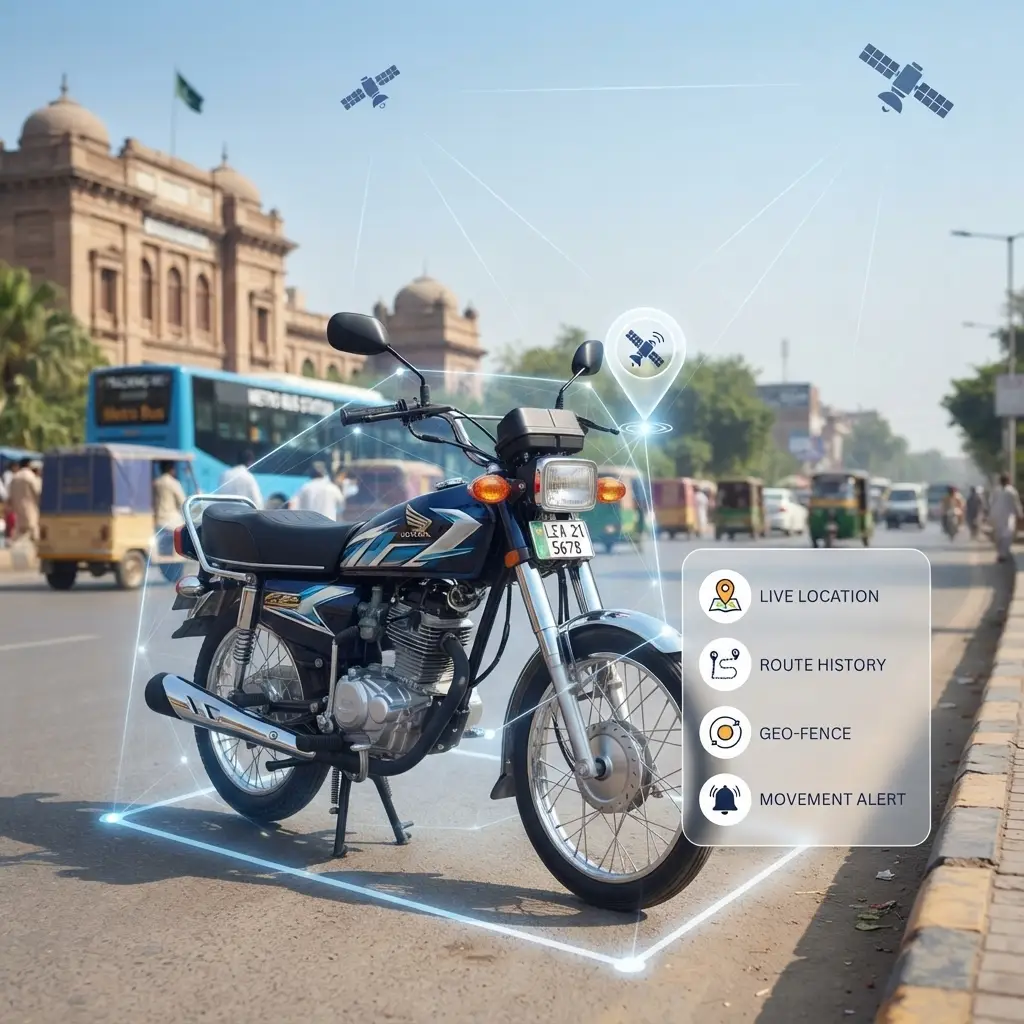
Motorcycles have become a vital mode of daily transport in Pakistan. Millions of people in cities like Lahore, Karachi, Islamabad, and Rawalpindi rely on them for commuting to work, business activities, delivery services, education, and personal travel. While motorcycles make commuting convenient and relatively affordable, security remains a significant concern.
Compared to cars, motorcycles are easier to move from one place to another. Consequently, relying solely on traditional locks or alarms is not always sufficient. Whether a motorcycle is parked in a designated area, outside a home, at an office, or in a market, the owner may find it difficult to verify if the bike is still where it was left or if it has been moved.
This is where the bike tracker emerges as a useful technology.
A modern GPS bike tracker can help monitor the motorcycle’s location and movement, track route history, and provide various alerts based on its specific features. This gives the owner greater visibility and control over their motorcycle.
But what exactly is a bike tracker? How does GPS tracking work? What features should one look for when buying a tracker? Are all trackers the same? And how can GPS tracking benefit motorcycle owners in Pakistan?
In this comprehensive guide, we will explore these key questions regarding bike trackers and GPS motorcycle tracking in a simple, easy-to-understand manner.
What is a Bike Tracker?
A bike tracker is a device used to monitor a motorcycle’s location and movement. Modern tracking solutions typically utilize GPS (Global Positioning System) technology to pinpoint the vehicle’s location.
The tracker is installed on the motorcycle, and location data is transmitted to a server or tracking platform. The user can then view the bike’s location and other relevant information via a web portal or mobile app. Simply put:
A bike tracker helps you know where your motorcycle is and track its movements.
While traditional security measures like locks offer basic protection, GPS tracking is designed to provide visibility of the vehicle’s location and enable monitoring.
For this reason, many motorcycle owners consider a bike tracker an additional component of their overall vehicle security strategy.
How does a bike tracker work?
Understanding how a GPS bike tracker works is not difficult.
Generally, a GPS tracking system consists of a few basic components:
GPS Satellite → Tracking Device → Communication Network → Tracking Server → Mobile App / Web Portal
First, the tracker determines the vehicle’s location using available GPS signals. Then, the tracking device transmits the relevant location data to the tracking system.
Once processed on the tracking server, this information can be viewed by the user via a mobile app or web portal.
For example, if your bike is parked in a parking area in Lahore and the tracking system is active, you can check its current location information through the supported platform.
Similarly, if the bike moves, that movement can be monitored based on the tracking solution’s specific capabilities.
This technology forms the basis of real-time tracking.
What is GPS, and what role does it play in bike tracking?
GPS stands for Global Positioning System.
GPS is a satellite-based navigation technology used worldwide for determining location and positioning. Smartphones, navigation systems, vehicle tracking solutions, and many other technologies utilize GPS.
When a GPS tracker is installed on a motorcycle, it can determine the vehicle’s position using GPS signals.
However, it is important to understand one key point:
GPS and the Internet are not the same thing.
GPS primarily helps determine location; however, to transmit that location to a remote server, the tracker may require a communication method—such as cellular or data connectivity—depending on the specific model and setup.
This is why the functionality, connectivity, and reporting capabilities of different bike tracker devices can vary.
What is the difference between a bike tracker and a standard bike alarm?
Many motorcycle owners believe that alarms and trackers perform roughly the same function, but they serve different purposes.
A traditional bike alarm typically emits a sound when unauthorized movement or a disturbance occurs. Its purpose is to alert the owner and people nearby.
In contrast, the primary purpose of a bike tracker is location monitoring and tracking. For example:
If someone moves the bike while the alarm is armed, the alarm can sound an alert.
However, if vehicle location monitoring is required, a GPS tracking system can provide more useful information—provided the specific tracker and service support this functionality.
Therefore, an alarm and a tracker should not necessarily be viewed as replacements for one another.
An optimal vehicle security strategy involves a combination of physical locks, responsible parking, and appropriate tracking or security technology.
Why is the demand for bike trackers growing in Pakistan?
Motorcycle usage is widespread in Pakistan. A large number of people rely on bikes daily for both short- and long-distance travel.
For a motorcycle owner, the bike is more than just a means of transport; for many, it serves as:
A daily commute to the office, an asset for business, a tool for delivery work, a mode of transport to university or college, or an essential vehicle for daily household errands.
Given this, bike security becomes a priority.
A bike tracker offers the owner greater visibility regarding their motorcycle. If the tracking solution supports the relevant features, the owner can monitor location, movement, routes, and receive various alerts.
Tracking is particularly useful for users who park their bikes in various locations or whose motorcycles are used by other family members or staff.
Key Benefits of Bike Trackers
Not all GPS bike trackers share the same specifications and features; therefore, one should verify the availability of specific features with the provider or device manufacturer. However, modern vehicle tracking systems generally offer the following capabilities:
1. Real-Time Tracking
Real-time tracking is a crucial GPS tracking feature.
Its purpose is to enable the user to view the vehicle’s current or most recently recorded location.
Suppose you have parked your motorcycle in a parking area. If you wish to verify its location later, you can check the available location data via the tracking platform.
This feature is also highly useful for business owners who utilize motorcycles for delivery or field operations.
Real-time tracking enhances vehicle visibility and reduces the need for the owner to repeatedly ask the rider for their location.
2. Location Monitoring
A primary benefit of bike tracking is location monitoring.
Users can monitor the motorcycle’s location through a supported tracking interface. This feature is beneficial for both personal bikes and motorcycles used for business purposes.
For instance, if an organization’s employees are using motorcycles across various locations, an appropriate tracking system can help in better understanding and managing operations. For individual users, this feature can be significant in terms of vehicle security and peace of mind.
3. Route History
Knowing only the current location is not always sufficient; in certain situations, it is also useful to know where the vehicle has previously traveled.
This is where Route History comes into play.
If the tracking system supports this functionality, the user can view information regarding previous trips or routes.
It can be utilized in various scenarios, such as:
reviewing business delivery routes, understanding vehicle usage, reviewing past journeys, or conducting operational monitoring.
In a business environment, historical tracking data can also assist with route planning and the analysis of vehicle usage.
4. Geo-Fencing
Geo-fencing is a useful feature of GPS tracking.
In simple terms, a geo-fence can be understood as a virtual geographical boundary.
For instance, a user can set a virtual boundary around a specific area. If the tracked vehicle enters or exits this boundary under configured conditions, the system can generate an alert or notification—provided the tracking solution supports this functionality.
This feature can be beneficial for both personal and business use cases.
For example:
A business can monitor its delivery area, or a motorcycle owner can keep an eye on any unusual movement outside their usual area of operation.
The purpose of geo-fencing is not to create a physical barrier but to provide a digital monitoring boundary.
5. Movement Alerts
Some tracking solutions offer movement alerts.
If a parked motorcycle moves unexpectedly, a supported tracking setup can alert the user.
This feature can be particularly useful for security monitoring, as the owner is not always present near their bike.
For example, if a bike is parked outside an office, market, or home and unexpected movement is detected, a timely notification can help the owner check the situation.
However, the exact type of alerts and the response time may depend on the tracker model, network, and service provider.
6. Ignition Alerts
Ignition ON/OFF alerts are also available in some vehicle tracking systems.
This type of functionality helps the user know exactly when the vehicle’s ignition is turned on or off.
It can be useful for business fleet monitoring in addition to personal security monitoring.
For example, if company motorcycles are assigned to field staff, information regarding vehicle activity can assist in monitoring operations.
Ignition monitoring is not available in every tracker, so it is best to verify the feature list with the provider before purchasing.
7. Mobile Monitoring
Nowadays, users prefer to view information on their smartphones.
Consequently, mobile apps or mobile-friendly tracking platforms have become essential in modern tracking solutions.
With a supported solution, the user can access the vehicle’s location and other tracking data directly from a mobile device.
The advantage of this is that the owner does not need to sit in front of a desktop computer at all times to monitor the vehicle. Tracking information can be checked via a supported system—whether at the office, at home, or while traveling—provided the necessary connectivity is available.
A Bike Tracker Is Not Just for Theft Prevention
A common misconception is that a bike tracker is used solely to locate a stolen motorcycle.
While security is certainly a key use case, GPS tracking offers a wider range of applications.
For example:
Vehicle Monitoring: Tracking the bike’s location and movement.
Route Monitoring: Reviewing the route taken by the motorcycle using available history.
Business Operations: Monitoring the activity of delivery or field-use bikes.
Family Use: Visibility of the vehicle’s location can be useful when a single motorcycle is shared among different family members.
Usage Monitoring: Understanding when and on which routes the vehicle was used via supported reports.
Therefore, rather than viewing a bike tracker merely as an “anti-theft device,” it is more accurate to see it as a vehicle visibility and monitoring solution.
Who Can Benefit from a Bike Tracker?
GPS motorcycle tracking offers various benefits to different types of users.
Daily Motorcycle Riders
Vehicle security is crucial for those who use their bikes daily for commuting to the office, university, or work.
If the bike is parked in various public parking areas, a tracking system provides an additional layer of monitoring.
Delivery Businesses
Motorcycles are commonly used in food delivery, courier services, e-commerce delivery, and field operations.
Such businesses can better understand the movement of riders and vehicles through appropriate GPS tracking.
This helps improve route visibility and operational monitoring.
Companies with Multiple Bikes
Some organizations maintain fleets of motorcycles for their field employees.
In such cases, repeatedly calling every rider to ask for their location is impractical.
With a centralized tracking platform, an authorized team can view tracking information for multiple vehicles in one place, depending on the specific solution used.
Families
A single motorcycle within a household may be used by different family members.
In such instances, location visibility can be useful for certain users—especially when the vehicle is out for extended periods or used across various locations.
Tracking should always be used with the vehicle owner’s consent and in compliance with applicable privacy regulations.
What to look for before buying a Bike Tracker?
Buying a device just because it says “GPS Tracker” is not a good decision. Hardware quality, tracking platform, connectivity, support and available features of different trackers may vary.
1. Tracking Accuracy
The main purpose of the tracker is to provide location information, so tracking performance is an important factor.
GPS performance can be affected by surroundings, satellite visibility, installation and other technical factors. Therefore, instead of unrealistic claims like “100% exact everywhere”, the actual specifications and service capability of the provider should be seen.
2. Tracking Platform
Good hardware is more useful when accompanied by a usable tracking platform.
Check before buying:
• Is the Mobile App available?
• Is there a Web Portal?
• Is the location easily visible?
• Is Route History available?
• What alerts are supported?
• Is the interface easy to understand or not?
3. Alerts and Notifications
Find out which alerts the tracker supports according to your needs.
For example, Movement Alert, Ignition Alert, Geo-Fence Alert or other relevant notifications.
It is better to confirm with actual package/device features provider instead of depending on marketing claim only.
4. Installation
Installation of GPS tracker is also important.
Poor installation can affect device performance or vehicle wiring. Therefore, professional installation and correct placement are important considerations.
Bike space is limited, so motorcycle tracker installation may differ from car installation.
5. After-Sales Support
Service may still be required after purchasing the Tracker.
For example, login issue, app configuration, device troubleshooting, account-related support or technical assistance.
Therefore, instead of looking at the initial price of the tracker, after-sales support should also be a part of the decision.
6. Total Cost
When evaluating the cost of a bike tracker, don’t just look at the device price.
Also ask the provider that in the applicable package:
Device Cost, Installation Charges, Subscription/Service Charges, Renewal Charges or other charges included or separate.
In this way, the chances of unexpected cost coming up later are reduced.
What is the difference between a cheap bike tracker and a professional tracking solution?
Tracking devices across various price ranges are available in the market, but making a decision based solely on a low price is not advisable.
The overall value of a tracking solution is derived from several factors:
Hardware + Installation + Tracking Platform + Connectivity + Features + Technical Support + Service Reliability
An inexpensive device might seem attractive initially, but if the tracking platform is difficult to use, support is unavailable, or a required feature is missing, the benefit of the low price becomes limited.
On the other hand, a high price tag does not automatically guarantee that a tracker is the best option.
The right approach is to identify your specific needs and then compare features, service quality, and total cost.
What is the difference between a bike tracker and a car tracker?
While the fundamental GPS tracking concept may be similar for both, the practical requirements for motorcycles and cars differ.
Installation space is limited on a bike, requiring more careful planning regarding device placement. Motorcycle usage patterns also differ from those of cars.
Car tracking solutions may offer advanced integrations tailored to the vehicle type and service package, whereas a motorcycle owner’s primary focus is often on compact installation, location monitoring, and security-related alerts.
Therefore, simply installing a car tracker in a bike—or assuming a bike tracker is equivalent to a car tracker—is not the correct approach.
You should inform the provider of the vehicle type so they can recommend the most suitable tracking solution.
Can a bike tracker prevent theft?
This is a crucial question.
A bike tracker should not be viewed as a guarantee against theft.
The primary benefits of a tracker are monitoring, location visibility, and alerts. Physical security measures—such as a high-quality lock and responsible parking—remain essential.
If a provider guarantees that a motorcycle “can never be stolen” after installing a tracker, such an absolute claim should be evaluated with caution.
GPS tracking can strengthen an overall security strategy, but no single technology can completely eliminate every possible theft scenario.
Therefore, the best approach combines:
Physical Security + Safe Parking + GPS Tracking + Timely Monitoring
Bike trackers and privacy
Privacy is also an important consideration when using GPS tracking. Tracking your own motorcycle for security and monitoring purposes is one thing, but secretly tracking another person or vehicle without their consent can raise privacy and legal concerns.
Businesses should also maintain clear tracking policies regarding company vehicles and employees.
GPS technology should always be used for legitimate vehicle monitoring and in compliance with applicable regulations.
Bike Tracker Price in Pakistan
“What is the price of a bike tracker in Pakistan?” is a question motorcycle owners often ask before making a purchase. However, it is not always possible to quote a fixed price, as features, hardware quality, installation, and service charges vary across different tracking devices and service packages.
The total cost of a GPS bike tracker does not depend solely on the price of the device itself; some tracking solutions may also include costs for installation, the tracking platform, connectivity, or subscription/service fees.
Therefore, when buying a bike tracker, one should not simply ask:
“How much does a bike tracker cost?”
Instead, a better question is:
“What features and services am I getting for this price?”
For instance, a basic tracking solution might offer only location monitoring, whereas another package could include features such as real-time tracking, route history, geo-fencing, ignition alerts, and more.
It is advisable to confirm current pricing and package details with the provider before selecting a tracking solution, as prices and packages are subject to change over time.
What factors determine the price of a bike tracker?
The price of a bike tracker can vary based on several factors.
Device Quality
The tracker’s hardware is a crucial factor. Build quality, GPS capabilities, connectivity options, and technical specifications can differ between devices.
Buying the cheapest device isn’t necessarily the best long-term decision.
Available Features
The price of a basic tracker differs from that of a feature-rich tracking solution.
A package offering real-time tracking, geo-fencing, route history, movement alerts, ignition monitoring, or additional reporting features will differ from a basic tracker package.
Installation Charges
Some providers include installation in the device price, while others charge separately for it.
It is advisable to confirm whether installation is included in the quoted price before purchasing.
Subscription or Service Charges
GPS tracking involves more than just hardware. Due to the tracking platform, connectivity, and related services, some providers may charge monthly or annual service fees.
Therefore, it is important to know the recurring costs alongside the initial purchase price.
After-Sales Support
Professional technical support can also be part of the overall service.
Reliable support becomes crucial if issues arise later regarding the tracker, mobile app, account, or tracking platform.
Don’t just compare prices when buying a bike tracker
Various GPS tracking devices are available in Pakistan’s online and local markets. Users often gravitate toward the cheapest option when they see significant price differences.
However, price comparison alone is not enough when selecting a tracking solution.
For instance, if two trackers have different prices, compare the following:
How accurate is the tracking?
Is a mobile app or web portal available?
For how long is route history stored?
Which alerts are supported?
Is professional installation available?
Who provides technical support?
What is the cost of service renewal?
Who should be contacted if a problem arises with the device or service?
In this way, the user compares a complete tracking solution rather than just a device.
How is a bike tracker installed?
Bike tracker installation is vital for the performance of the tracking system. The tracker is installed in a suitable location on the motorcycle where the device remains secure and does not interfere unnecessarily with the vehicle’s normal operation.
The exact installation process may vary depending on the tracker model, motorcycle type, and device specifications.
Therefore, professional installation is recommended.
Improper installation can lead to issues regarding wiring, the power supply, or the tracker’s performance.
Careful selection of the tracker’s placement is essential, especially given the limited space available on a motorcycle.
Instead of modifying the wiring themselves, the user should have the installation performed by a trained technician.
Does the bike tracker use the bike’s battery?
This depends on the tracker model and the installation setup.
Many vehicle tracking devices draw power from the vehicle’s electrical system, while some devices may also include an internal or backup battery.
Power consumption varies according to the device specifications.
Therefore, before purchasing a bike tracker, be sure to ask the provider the following questions:
What are the tracker’s power requirements?
Will the tracker be connected to the motorcycle’s battery?
Is there a backup battery included?
How does the tracker behave if the bike remains parked for several days?
It is best to confirm this information with the provider based on the specific tracker model.
Does a bike tracker use a SIM card?
Many GPS tracking systems use cellular networks or data connectivity to communicate location information to a server.
SIM-based connectivity may be used within the tracker setup for this purpose.
It is important to understand the difference between GPS and a SIM card here.
GPS helps determine the vehicle’s location.
A SIM card or cellular network, on the other hand, is used to transmit that location data to the tracking server.
In other words, the SIM card itself does not calculate the motorcycle’s location.
The exact communication technology depends on the tracker model and the provider’s system.
Does a bike tracker work without the internet?
The answer to this question is somewhat technical.
The processes of determining GPS location and remotely displaying that location to the user are distinct.
A tracker can determine its location using GPS signals, but a communication network may be required to transmit this information to a remote tracking server or the user.
If network connectivity is temporarily unavailable, the tracker’s behavior will depend on the device’s design.
Some tracking systems can temporarily store data and synchronize it once connectivity is restored, while other devices may operate differently.
Therefore, it is essential to check the device specifications before making a claim that a particular tracker “works completely without the internet.”
What is the difference between a GPS signal and a mobile network?
Understanding this distinction is very useful when dealing with bike trackers.
GPS Signal:
Helps determine the location.
Mobile/Cellular Network:
Can be used to transmit location and other tracking information to the server.
Tracking Server:
Processes and stores information received from the device.
Mobile App / Web Portal:
Displays tracking information to the user.
Simple flow:
GPS Satellites → Bike Tracker → Cellular/Data Network → Tracking Server → Mobile App/Web Portal
The exact implementation of this process may vary depending on the provider’s tracking system.
What happens if there is no mobile network?
Network coverage can affect the remote communication capabilities of a GPS tracking solution.
If the bike travels to an area where the relevant cellular network is temporarily unavailable, there may be a delay in real-time information updates. Some devices offer offline data storage capabilities, allowing them to transmit information to the server once network connectivity is restored.
However, this feature is not necessarily available in every tracker.
Therefore, when purchasing a tracker, verify the availability of offline data storage and network-related functionalities with the provider.
What does a bike tracker mobile app do?
A mobile app can be a crucial part of the user experience in a modern tracking solution.
Depending on the available features, a user can utilize the mobile app to:
view the bike’s location, review previous routes, manage geo-fences, check alerts, and monitor vehicle activity.
However, app functionality varies depending on the provider.
Before purchasing a tracker, it is useful to examine the mobile app demo or tracking interface, rather than just looking at the hardware device itself.
If the hardware is excellent but the app is difficult or confusing to use, the user may face problems during daily operation.
How accurate is real-time bike tracking?
GPS tracking accuracy can be influenced by various environmental and technical factors.
GPS reception is generally better in open areas, whereas covered parking, underground locations, tall buildings, or signal obstructions can impact accuracy.
Device quality, antenna placement, and installation also play a role in tracking performance.
Therefore, it is not practical to expect centimeter-level location precision from a GPS tracker at all times.
The goal of a reliable tracking solution is to provide the user with useful vehicle location information and monitoring capabilities.
How can geo-fencing assist with bike security?
Suppose your motorcycle typically stays within a specific geographical area.
You can configure a geo-fence around that area within the tracking system.
If the bike moves outside the configured boundary—and the tracking solution supports relevant alerts—a notification can be generated.
This feature is particularly useful for business bikes, delivery motorcycles, or monitored vehicles.
However, a geo-fence should not be considered a physical security barrier.
It is a digital monitoring feature.
Why is route history useful?
Route history does not merely indicate the bike’s current location; in a supported system, it can also display information about past journeys.
Individual users can review their past vehicle usage.
Business owners can analyze delivery routes or field movements.
Companies can gain a better understanding of their operational patterns.
If multiple motorcycles are in use, historical data can also assist with operational planning. For this reason, when selecting a bike tracker, it is useful to ask how long the route history remains available and in what format it can be viewed.
Difference Between Personal and Business Bike Tracking
For personal motorcycle owners, the primary objective is often security and location visibility.
Requirements for businesses can be more detailed.
For instance, a delivery company might need to monitor the locations, routes, and operational activities of multiple bikes.
A simple bike tracker may suffice for a personal user, whereas a business might require a more comprehensive fleet tracking solution.
Therefore, it is important to clearly explain your specific use case to the tracking provider.
Bike Tracking for Delivery Businesses
In Pakistan, motorcycles are commonly used for food delivery, courier services, e-commerce, and field services.
Manual monitoring can be difficult if a business operates multiple delivery bikes.
An appropriate GPS tracking solution can help a business track vehicle locations and access data regarding routes and operational activity.
For example, management can understand which area a vehicle is in, how routes are being utilized, and the nature of operational movements.
This information can facilitate better planning and monitoring.
However, the tracking of employees or riders must align with transparent company policies and applicable privacy regulations.
Step-by-Step Guide to Selecting a Bike Tracker
If you are buying a bike tracker for the first time, you can follow this simple process.
Step 1: Identify Your Requirements
First, decide why you need the tracker.
Personal security?
Monitoring a family motorcycle?
Delivery bike?
Business motorcycles?
Requirements may vary for each use case.
Step 2: List Required Features
For example:
Real-Time Tracking
Route History
Geo-Fencing
Movement Alerts
Ignition Alerts
Mobile App
Prioritize the features that are truly essential.
Step 3: Inquire About Total Cost
Don’t just ask for the device price.
Find out about installation, service charges, renewals, and other applicable costs.
Step 4: Check the Tracking Platform
If possible, view a demo of the mobile app or web portal.
Step 5: Confirm Support Services
How will you receive support if a technical issue arises after installation?
Phone support?
On-site support?
Technical team?
It is best to clarify this beforehand.
Step 6: Assess the Provider’s Credibility
Vehicle tracking is often an ongoing service; therefore, the provider’s experience, support infrastructure, and business credibility are important.
Common Myths About Bike Trackers
Myth 1: A bike cannot be stolen once a tracker is installed
This is incorrect.
A GPS tracker provides monitoring and location visibility but does not offer an absolute guarantee against theft.
Physical security measures remain necessary.
Myth 2: All GPS trackers are the same
No.
Hardware, software, features, support, connectivity, and service quality can vary.
Myth 3: The most expensive tracker is always the best
Not necessarily.
The best tracker is the one that effectively meets your specific requirements.
Myth 4: Trackers are only useful for stolen bikes
No.
Bike trackers are also useful for location monitoring, tracking routes, managing business operations, and monitoring vehicle usage.
Myth 5: GPS trackers and SIM trackers are the same thing
This terminology can be confusing.
GPS is used to determine the vehicle’s location, whereas cellular/SIM connectivity is used to transmit the tracking data.
Security Tips for Using a GPS Bike Tracker
A bike tracker should be just one component of your motorcycle’s overall security.
Park the bike in a secure and visible location whenever possible.
Use a high-quality physical lock.
Do not leave bike keys unattended.
Maintain a strong password for your tracker account.
Do not share mobile app login details with unauthorized individuals.
Keep notifications enabled if the tracking solution provides relevant alerts.
Do not ignore unusual movement or alerts.
Combining tracking technology with responsible physical security practices is the best approach.
Bike Tracker in Lahore
In a major city like Lahore, motorcycles play a vital role in daily commuting.
They are widely used across office districts, commercial markets, universities, shopping hubs, and residential areas.
In such an environment, having visibility into the vehicle’s location can be highly beneficial for motorcycle owners.
If you are searching for a bike tracker in Lahore, do not focus solely on device availability when selecting a provider; also consider installation and after-sales support.
Local technical support can prove valuable for future troubleshooting and service needs.
Bike Tracker in Pakistan
Motorcycle usage is extensive across various cities in Pakistan, and tracking requirements vary from user to user.
An individual user might simply need basic monitoring, whereas a business might require a tracking system for a fleet of vehicles.
Therefore, when selecting a bike tracker in Pakistan, it is important to evaluate the solution based on your specific needs.
Beyond price, factors such as service coverage, available features, installation, the tracking platform, and support are also crucial.
Why Choose Tracking World for Vehicle Tracking?
When selecting a vehicle tracking solution, the provider’s experience and support are just as important as the technology itself.
Tracking World provides vehicle tracking and related monitoring solutions in Pakistan. Users can consult the Tracking World team to learn about available solutions tailored to their vehicle type and tracking requirements.
When considering a bike tracking solution, customers should first discuss their required features—such as location monitoring, available alerts, the tracking platform, and installation requirements.
This allows the provider to explain the best available options based on the specific vehicle and use case.
Important: Before publishing, please verify the exact current features, package availability, charges, and service coverage of the bike tracker with the Tracking World Product Team. Include only those commercial claims in the article that the company officially offers.
Frequently Asked Questions About Bike Trackers
1. What is a Bike Tracker?
A bike tracker is an electronic tracking device used to monitor a motorcycle’s location and movement. Modern solutions typically utilize GPS technology and a tracking platform.
2. How does a GPS Bike Tracker work?
A GPS bike tracker determines the vehicle’s location using satellite signals and transmits tracking data to a server via a supported communication network. Users can view this information on a mobile app or web portal.
3. What is the price of a bike tracker in Pakistan?
The price of a bike tracker in Pakistan varies based on the device, features, installation, and service package. You should confirm the current price with the provider.
4. Can I track my bike from my mobile phone?
If the selected tracking solution supports a mobile app or a mobile-accessible platform, the user can view tracking information on their smartphone.
5. Does a bike tracker require a SIM card?
Many GPS trackers use cellular/SIM-based connectivity to communicate with the server. The exact setup may vary depending on the tracker model.
6. Does GPS tracking require the internet?
Determining GPS location and remote data communication are separate processes. Remote tracking may require the tracker setup to have communication connectivity.
7. Can a bike tracker prevent theft?
A bike tracker does not guarantee 100% prevention of theft. However, it can strengthen the overall vehicle security strategy through location monitoring and security alerts.
8. What is real-time tracking?
Real-time tracking allows the user to view the vehicle’s current or latest available location on the tracking platform. The frequency of updates depends on the system and connectivity.
9. What is geo-fencing?
Geo-fencing is a virtual geographical boundary. A supported tracking system can generate an alert when the vehicle enters or exits the configured boundary.
10. Can I view my bike’s route history?
If the selected bike tracker and tracking platform support the route history feature, previous routes or trips can be viewed.
11. Can a bike tracker drain the motorcycle battery?
Power consumption depends on the tracker model and installation. Before purchasing, confirm the device’s power requirements and battery specifications with the provider.
12. Is a bike tracker useful for delivery businesses?
Yes, GPS tracking can help delivery businesses monitor the location, routes, and operational activity of motorcycles, depending on the selected system.
13. Is a Bike Tracker different from a Car Tracker?
While the basic concept of GPS tracking may be similar, the installation process, available space, and use cases differ for motorcycles. The appropriate device should be selected based on the vehicle type.
14. Where should a Bike Tracker be installed?
A technician determines the exact placement based on the specific motorcycle and tracker model. Professional installation is recommended to ensure the device is secure and properly integrated with the vehicle’s system.
15. Can I use one App to monitor multiple Bikes?
Some tracking platforms offer the capability to manage multiple vehicles under a single account or dashboard. You should verify this feature with the service provider and check the specific package details.
Conclusion
Security, location visibility, and vehicle monitoring are increasingly important considerations for motorcycle owners. A bike tracker is a useful technology that helps monitor a motorcycle’s location and movement.
Depending on the features offered, a suitable GPS bike tracker can provide capabilities such as real-time tracking, route history, geo-fencing, movement alerts, ignition alerts, and mobile monitoring.
However, price should not be the only factor considered when purchasing a tracker.
One should also evaluate device quality, installation, the tracking platform, connectivity, available features, service charges, and after-sales support.
Most importantly, a GPS tracker should not be viewed as a guarantee of total security; physical locks, responsible parking, and safe riding practices remain essential.
If you are considering a tracking solution for your motorcycle in Pakistan, first identify your requirements and then choose a solution that aligns with your actual usage needs.
Looking for a Bike Tracking Solution in Pakistan?
Contact the Tracking World team to learn about available GPS tracking solutions, features, installation, and current package details for your motorcycle.
Request a Quote | Talk to an Expert | Contact Tracking World