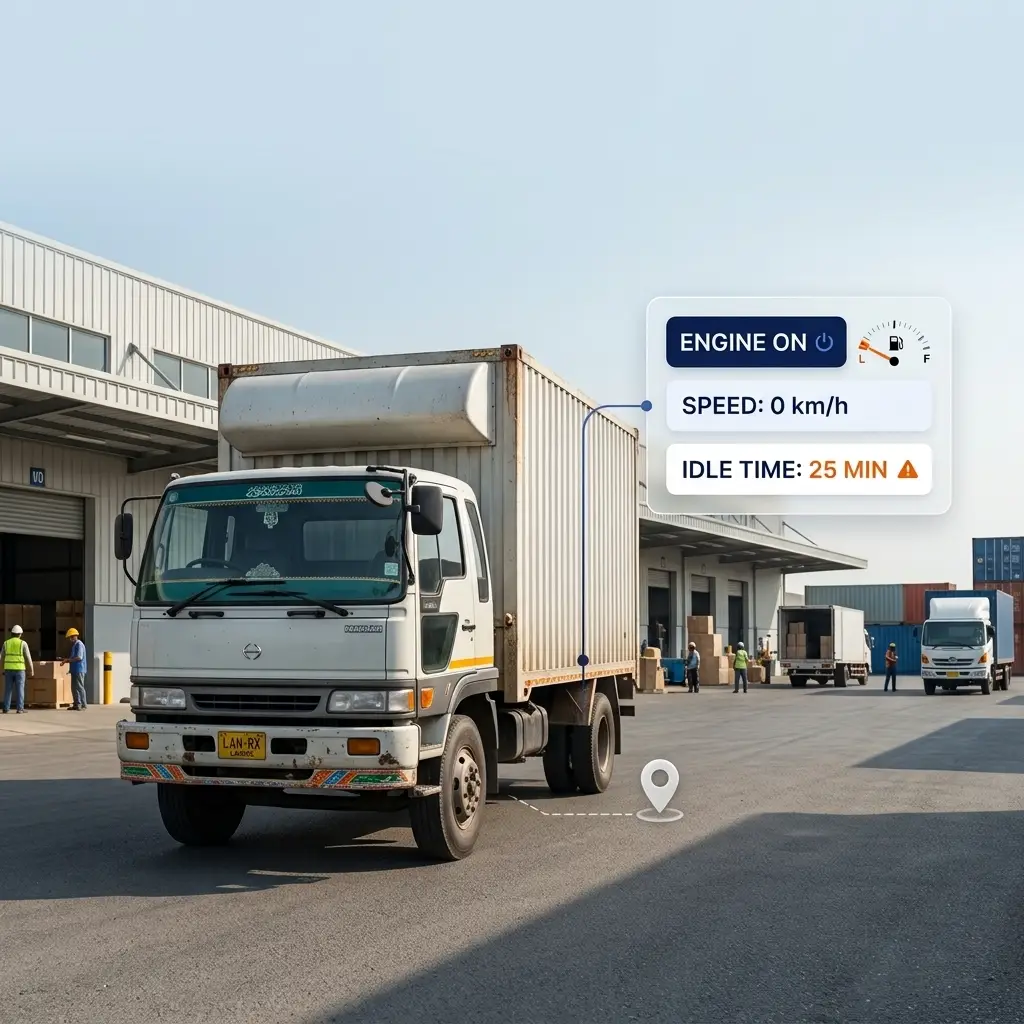
For companies operating in the transport and logistics sector in Pakistan, fuel costs represent a significant challenge. Vehicles are dispatched to various locations daily—some for transporting goods, others for ferrying company employees, and some for delivery and distribution tasks. Fuel is consumed throughout these operations; however, it is not always consumed solely because the vehicle is in motion.
At times, a vehicle remains stationary while its engine continues to run—perhaps while the driver waits for someone, during the loading of goods, or while the vehicle is parked at a delivery point. In such instances, although the vehicle covers no distance, the engine continues to consume fuel.
This scenario is known as “vehicle idling.”
While unnecessary idling by a single vehicle might not seem like a major issue at first, for a company operating a fleet of 20, 50, or 100 vehicles, even a few extra minutes of idling per day can accumulate into several hours overall.
Consequently, in modern fleet management, simply knowing a vehicle’s location is no longer sufficient. Companies must also understand where their vehicles stop, the duration of these stops, and whether the engine remains running or is switched off during these periods.
GPS fleet tracking and vehicle idling monitoring can help address this issue.
In this article, we will explore in detail what vehicle idling is, its underlying causes, how it impacts fuel and operating costs, and how fleet managers in Pakistan can leverage GPS tracking data to reduce unnecessary idling.
What Is Vehicle Idling?
Vehicle idling refers to a situation where a vehicle’s engine is running, but the vehicle itself is not in motion. For example, a delivery van arrives outside a warehouse to drop off goods. The driver parks the vehicle but does not turn off the engine. It takes 15 minutes for the person receiving the goods to arrive. During this time, the delivery van remains in the same spot with its engine running.
These 15 minutes can be classified as “vehicle idling,” provided that the relevant monitoring system is capable of accurately detecting the engine’s status during this period.
Similarly, an office vehicle might arrive to pick up employees. If the employees are not yet ready and the driver waits for 20 minutes—with the engine left running—this duration can also be categorized as vehicle idling.
Vehicle idling is not limited to commercial vehicles; it can occur with cars, vans, buses, trucks, and any other engine-powered vehicles.
However, not every instance of a vehicle coming to a stop qualifies as idling.
If a vehicle is stationary and the engine is turned off, it is simply considered parking or a standard stop. Conversely, if a vehicle is stationary while the engine is running, it is classified as idling.
This distinction is crucial for fleet management.
DIFFERENCE BETWEEN VEHICLE STOPPAGE AND VEHICLE IDLING
In some companies, a “vehicle stop” and “vehicle idling” are mistakenly treated as the same thing. In reality, they are distinct concepts.
A “vehicle stoppage” occurs whenever a vehicle comes to a halt at a specific location; during this time, the engine could be either off or running.
“Vehicle idling,” on the other hand, refers specifically to a situation where the engine is running while the vehicle remains stationary.
For instance, consider a truck parked outside a warehouse for two hours.
If the truck’s engine is turned off, those two hours are counted as parking or a stoppage.
If, however, the engine remains running for 40 minutes out of those two hours, the vehicle monitoring system may record that specific duration as idling. GPS location alone does not always reveal the true state of the engine. Accurate monitoring of vehicle idling may require data such as ignition status, engine parameters, or other reliable device information.
Therefore, before selecting a fleet tracking solution, it is essential to determine whether it merely records vehicle stops or is actually capable of measuring engine idling.
This is particularly important for companies that wish to gain a better understanding of their fuel expenses.
Why Vehicle Idling Matters for Fleet Businesses in Pakistan
Companies operating fleets in Pakistan face various operational challenges.
Traffic congestion in cities, delivery delays, disorganized loading areas, long waiting times, and varying route conditions all impact daily operations.
In major cities like Lahore, Karachi, and Islamabad, commercial vehicles often encounter slow-moving traffic at different times of the day.
A delivery vehicle typically visits multiple locations throughout the day. At each stop, time is spent unloading goods, obtaining receipts, or interacting with customers.
If a driver leaves the engine running at every stop instead of turning it off, fuel consumption increases.
This issue becomes particularly significant when management lacks a clear record of this time.
A fleet manager might know that a vehicle traveled 120 kilometers in a day, but they may not know how long the engine remained running unnecessarily.
Two vehicles might cover the same distance, yet their fuel consumption could differ. This discrepancy can stem from various factors, including route conditions, the vehicle’s mechanical state, the load carried, driving behavior, and idling.
Monitoring vehicle idling sheds light on one of these critical operational factors.
The goal is not merely to reduce fuel consumption, but also to make fleet utilization more organized and measurable.
Common Causes of Excessive Vehicle Idling
Unnecessary vehicle idling is not always the result of driver negligence. Sometimes, the issue lies within the company’s operations, delivery schedules, or waiting processes.
Therefore, rather than solely blaming the driver, it is essential to identify the root cause of the idling.
1. Waiting at Delivery Locations
Many delivery vehicles are required to wait for the completion of receiving procedures after dropping off goods.
If the customer or warehouse staff is not available on time, the vehicle may remain stationary for an extended period.
If the engine is left running during this time, fuel continues to be consumed. The solution to this problem is not limited to merely instructing the driver; the company must also improve delivery scheduling and customer coordination.
2. Loading and Unloading Delays
Trucks and vans may have to wait for loading or unloading at factories, warehouses, and distribution centers.
At certain locations, many vehicles arrive simultaneously, resulting in long queues.
If management identifies which warehouses cause the longest wait times for vehicles, they can optimize the loading schedule.
3. Unnecessary Engine Running
Some drivers habitually leave the engine running while waiting.
They often believe that repeatedly turning the engine off and restarting it consumes more fuel.
However, this assumption is not necessarily true for every vehicle or every situation.
Factors such as the engine restart process, battery condition, manufacturer guidelines, and the expected duration of the stop must be considered.
Generally, reducing prolonged, unnecessary idling is beneficial; however, any policy regarding engine shutdown should account for the specific vehicle type and safety requirements.
4. Air Conditioning Requirements
In Pakistan, air conditioning becomes a significant necessity during the summer.
Drivers sometimes keep the engine running to operate the air conditioning while the vehicle is stationary.
This requirement may vary depending on the nature of the operation—such as passenger transport, specific field operations, or the transport of sensitive goods.
Therefore, not all idling related to air conditioning should be classified as “unnecessary.”
Fleet managers must distinguish between idling that is truly essential and idling that could be reduced through better planning.
5. Poor Route and Trip Planning
If a vehicle is repeatedly sent to locations with long wait times, the amount of idling will inevitably increase.
Inefficient delivery sequences, poorly scheduled appointments, and inadequate route planning can further exacerbate this issue.
Using GPS tracking data, it is possible to identify which routes and locations frequently result in long, extended stops.
6. Traffic Congestion
Vehicles may be forced to stop due to traffic signals, road construction, or heavy traffic congestion. However, a vehicle stuck in traffic and one waiting unnecessarily outside a warehouse are not the same situation.
To accurately assess fleet performance, it is essential to distinguish between these two scenarios.
Necessary Idling vs. Unnecessary Idling
The goal of reducing vehicle idling should not be that every vehicle must immediately shut off its engine at every stop.
In certain commercial operations, keeping the engine running is necessary.
For instance, some vehicles may require the engine to be running to provide electrical or mechanical power to specialized equipment.
Similarly, for some passenger services, climate control may be essential.
This can be classified as “operational idling.”
Conversely, idling that serves no clear operational purpose can be considered unnecessary or “avoidable” idling.
Three questions are key to distinguishing between the two:
First: Where was the vehicle parked?
Second: Why was the engine left running?
Third: Could the task have been completed safely and effectively with the engine turned off?
If a delivery van driver waits outside a warehouse for 30 minutes with the engine running—without any operational requirement—there is likely room for improvement.
However, if the engine is necessary to operate safety or operational equipment on a specific type of vehicle, the situation is different.
A sound fleet idling policy takes specific circumstances into account, rather than making decisions based solely on raw data.
How GPS Fleet Tracking Detects Vehicle Idling
The primary function of GPS fleet tracking is to provide information regarding a vehicle’s location and movement.
However, for fleet management purposes, some systems utilize additional data.
This data may include ignition status, speed, trip history, engine information, and the duration of stops.
When the system detects that the engine is running while the vehicle remains in the same location for a specific period, it can record an “idling event.”
This process can generally be broken down into a few steps.
Step 1: Vehicle Location Is Recorded
The GPS device determines the vehicle’s location.
This reveals where the vehicle is situated and what its movement status is.
Step 2: Vehicle Movement Is Checked
The system monitors changes in the vehicle’s speed or position.
If a vehicle remains in one location, it can be considered to be in a “stationary state.”
However, a stationary state alone does not confirm that the engine is running.
Step 3: Engine Status Is Verified
If the vehicle tracking device can access relevant engine or ignition data, the system attempts to determine the engine’s status.
The method for obtaining this information may vary depending on the specific device used.
Step 4: Idle Duration Is Measured
If the engine is running while the vehicle remains stationary for longer than a defined threshold, the duration of this idling can be recorded.
For instance, in a fleet, any instance where the engine remains running while the vehicle is stationary for more than five minutes could be flagged for review.
This is merely an example; the actual threshold should be determined based on the vehicle type, operational conditions, and system settings.
Step 5: Reports Are Reviewed
Fleet managers can consult relevant reports to see the extent of idling for each vehicle and identify specific locations where this occurs frequently.
This information can serve as a basis for making better decisions regarding fleet operations.
How to Measure Vehicle Idling Time Accurately
Monitoring idling is most effective when a company adopts a clear, consistent measurement method.
If different rules are applied to different vehicles, comparing performance becomes difficult.
For example, if a company defines a two-minute stop as “idling” for some vehicles, but a ten-minute stop for others, a direct comparison of the reports would not be accurate.
A better approach is to first categorize the fleet.
Delivery vans, long-haul trucks, passenger vehicles, and service vehicles all perform different functions.
Consequently, the appropriate idling threshold may vary for each category.
Next, the reporting period should be established.
Daily, weekly, and monthly reports can each address different types of inquiries.
A daily report, for instance, can highlight unusual events that occurred on a specific day. Weekly reports can reveal recurring patterns related to specific drivers or routes.
Monthly reports allow for a more systematic assessment of improvements or deterioration.
Key Idling Metrics
Total Idle Time: The cumulative duration a vehicle’s engine remains idling.
Average Idle Time per Vehicle: The mean idling time per vehicle within a fleet or a selected group of vehicles.
Idle Events: Instances where idling duration exceeds a predefined threshold.
Idle Time by Location: Idling recorded at various specific locations.
Idle Time per Operating Hour: The amount of idling relative to a vehicle’s total operating time.
Repeated Idle Locations: Locations where vehicles frequently keep their engines running for extended periods.
Taken together, these metrics provide a clearer, more comprehensive picture.
Relying solely on “Total Idle Time” is insufficient, as a vehicle with a higher workload may naturally accumulate more total idle time than others.
For an accurate comparison, one should also consider vehicle utilization and operating conditions.
8 Practical Ways to Reduce Vehicle Idling Time
Simply installing a GPS tracking device is not enough to reduce vehicle idling.
While technology can provide data, real improvement occurs only when a company uses this information to enhance its operations.
The following methods can be useful for fleet managers:
1. Establish a Clear Vehicle Idling Policy
First, the company must define the circumstances under which vehicle idling is necessary and when it should be minimized.
This policy should be written in simple, accessible language for drivers.
It should clearly outline when it is appropriate to turn off the engine during long waits, which specific rules apply to different types of vehicles, and what exceptions exist for safety reasons.
The goal of the policy should not merely be to impose restrictions, but to assist drivers in making better decisions.
2. Identify Vehicles with High Idling Rates
Fleet tracking reports can help identify vehicles that record high levels of idling.
However, simply identifying the vehicle with the most idle time is not sufficient.
A fleet manager should also consider factors such as the number of trips the vehicle makes, its assigned routes, and its specific operational duties.
For example, a delivery van might have higher daily idling than another van simply because it is required to stop at more delivery locations.
Therefore, the nature of the work must be taken into account during the assessment.
3. Review Locations with Frequent Idling
If multiple vehicles consistently experience long wait times outside the same warehouse or distribution center, the issue may lie with the processes at that location rather than with the drivers.
GPS data can be used to pinpoint such locations.
The company can then coordinate with warehouse management to optimize delivery slots or adjust loading schedules.
The advantage of this approach is that it avoids attributing the problem solely to driver behavior.
4. Improve Delivery Scheduling
Inefficient delivery scheduling can cause vehicles to arrive ahead of their designated time, leading to prolonged waiting periods. If a company has access to trip history and waiting patterns, it can establish more appropriate delivery windows.
For instance, if there is a long queue at a customer’s location every day at 10:00 AM, but the wait time is shorter in the afternoon, adjusting the delivery timing could improve the situation.
However, any such change should be made while keeping customer requirements and delivery deadlines in mind.
5. Train Drivers Using Actual Data
Driver training can be more effective when it utilizes real operating data rather than relying on general advice.
For example, a fleet manager could point out to a driver that their vehicle remained stationary for an unnecessarily long time at three different locations over the past week.
The driver could then be asked to explain the reasons behind these occurrences.
The driver might identify an operational issue that management was previously unaware of.
In this way, data combined with driver feedback can lead to practical solutions.
6. Set Appropriate Idle-Time Thresholds
It is incorrect to classify every instance of a vehicle remaining stationary as a problem.
Therefore, management should establish a threshold that aligns with the specific needs of the fleet.
For instance, a company might choose to flag instances where an engine remains running while the vehicle is stationary for an extended period.
Conversely, brief stops at traffic signals or pauses for necessary operational activities should be treated differently.
Before setting a threshold, it is also important to confirm with the technical team how the tracking system detects idling.
7. Review Performance Weekly
Reducing idling should not be a one-time initiative.
Fleet managers should review reports on a weekly basis.
This review process could incorporate several key questions:
Has the total idle time decreased compared to the previous week?
Is the waiting time still high on any specific route?
Has the new delivery schedule led to any improvements?
Has there been a sudden increase in idling for any particular vehicle?
Such questions assist management in making data-driven decisions.
8. Acknowledge Operational Improvements
When evaluating driver performance, the focus should not be solely on mistakes. If a driver or team demonstrates a positive improvement in reducing unnecessary idling, they should be recognized for it.
Positive feedback helps the team understand that the purpose of monitoring is not merely surveillance, but rather the improvement of operations.
This approach can foster driver cooperation and contribute to long-term improvement.
How to Calculate the Cost of Vehicle Idling
A simple calculation can be used to understand the financial impact of vehicle idling.
However, it is important to note that fuel consumption varies from one vehicle to another.
Idle fuel consumption can differ based on factors such as engine size, vehicle type, air conditioning (AC) usage, load, and the condition of the engine.
Therefore, the following calculation serves only as an illustrative example and does not represent the actual results of any Tracking World customer.
Suppose a company operates 20 delivery vehicles.
On average, each vehicle idles for 30 minutes daily—idling that could potentially be reduced.
Each vehicle is in operation for 26 days per month.
For the purpose of this calculation, assume that a vehicle consumes approximately 1 liter of fuel per hour while idling.
For this example, the fuel price is set at PKR 280 per liter; this does not reflect the current market price.
Step 1: Daily Idle Hours
30 minutes = 0.5 hours
Step 2: Monthly Idle Hours per Vehicle
0.5 × 26 = 13 hours
Step 3: Monthly Idle Hours for 20 Vehicles
13 × 20 = 260 hours
Step 4: Estimated Monthly Fuel Consumption
260 hours × 1 litre = 260 litres
Step 5: Estimated Monthly Fuel Cost
260 litres × PKR 280 = PKR 72,800
In this hypothetical example, the estimated monthly fuel cost related to idling for 20 vehicles amounts to PKR 72,800.
However, this entire amount should not be considered an automatic saving.
Some idling may be necessary, while other instances might be unavoidable.
If a company can reduce this hypothetical idling time by 25% through appropriate operational changes, the calculation would be as follows:
260 hours × 25% = 65 hours
65 hours × 1 litre = 65 litres
65 litres × PKR 280 = PKR 18,200
In this example, the potential monthly fuel saving amounts to approximately PKR 18,200.
This scenario is used solely to illustrate the calculation.
To determine actual savings, a company should use data specific to its own vehicles, including idle fuel consumption rates, actual fuel prices, engine data, and operational requirements.
Why Small Reductions Matter in Large Fleets
Some fleet owners might wonder what difference reducing daily idling by ten or fifteen minutes could possibly make.
However, in a large fleet, even a small difference like this can be significant.
Suppose that in a company with 50 vehicles, the avoidable idling for each vehicle is reduced by just 10 minutes per day.
The total saving across all vehicles would amount to approximately 500 minutes per day. This amounts to more than eight hours.
If this improvement is sustained, the total number of “idle hours” could be significantly reduced over the course of a month.
This does not mean that every company will necessarily save this much fuel.
The actual benefit will depend on the number of vehicles, engine characteristics, and the number of operating days.
However, this example illustrates that even small operational improvements in fleet management can be significant on an overall scale.
For this reason, vehicle idling should be viewed as a fleet-level metric rather than merely an issue concerning an individual driver or a single vehicle.
Vehicle Idling Reports: What Fleet Managers Should Monitor
Many companies possess vehicle tracking data but lack a clear process for utilizing it.
Data is only valuable when it is used to answer specific operational questions.
A useful vehicle idling report might include the following information:
Vehicle Identification
The report should clearly indicate which vehicle the data pertains to.
Using a vehicle number or fleet ID allows for the tracking of individual vehicle records.
Date and Time
When did the idling begin, and when did it end?
This information is particularly useful for companies where vehicles operate across different shifts.
Location
Was the vehicle parked outside a warehouse?
Was it at a delivery point?
Was it located in a transport yard or a parking area?
Without context regarding the location, it can be difficult to determine the true cause of the idling duration.
Duration
How long did a single idling event last?
Did the vehicle remain idle for five minutes, or for 45 minutes?
Based on the duration, managers can select specific events for further review.
Repeated Patterns
Does a vehicle remain idle for long periods at the same location every day?
Is there excessive waiting time on a particular route?
Does idling increase during certain working hours?
Identifying these recurring patterns can help management uncover issues that might otherwise be overlooked during routine daily operations.
Comparison with Previous Period
Looking solely at the ‘Total Idle Time’ for a single month does not provide a clear picture of the overall situation.
A better approach is to conduct a comparison with the previous period.
If there has been a significant change in the number of vehicles or the number of trips, this should also be factored into the comparison.
For instance, an increase in the number of vehicles within a fleet can lead to an increase in ‘Total Idle Hours,’ even if the performance of individual vehicles is actually improving.
Therefore, relative metrics and operational context are essential.
How to Build a Monthly Vehicle Idling Report
A company can create a useful monthly vehicle idling report without making it overly complex.
It may include the following information:
| Metric | Information Required |
|---|---|
| Total Vehicles | Active vehicles during the reporting period |
| Total Idle Hours | Total recorded idling time |
| Average Idle Time | Average idling per vehicle |
| High-Idling Vehicles | Vehicles with high idling levels |
| Repeated Locations | Locations where frequent idling occurred |
| Previous Month Comparison | Variance compared to the previous month |
| Operational Remarks | Potential reasons for the idling |
| Action Taken | Measures implemented to mitigate the issue |
Through this report, a fleet manager can not only track the extent of idling but also understand the actions taken by management in response to this data.
For example, if delivery schedules were adjusted to reduce wait times at a warehouse, the impact of this change can be observed in the subsequent report.
This approach transforms vehicle idling monitoring into a process of continuous improvement.
Vehicle Idling Management for Different Fleet Types
The nature of operations varies from one fleet to another.
Consequently, a single, uniform idling policy may not be optimal for all types of vehicles.
Delivery and Distribution Fleets
Delivery vehicles make multiple stops throughout the day.
A key question for them is how much waiting occurs at each delivery point.
Fleet managers should identify locations where frequent, unnecessary waiting takes place.
Delivery scheduling and coordination with customers can play a significant role here.
Corporate Transport Fleets
Corporate vehicles are often used to pick up and drop off office staff.
In these cases, long waiting times can sometimes stem from the nature of the pickup arrangements.
Optimizing pickup schedules can help reduce unnecessary engine idling.
Logistics and Freight Fleets
Trucks and heavy commercial vehicles may face long wait times at warehouses, terminals, and checkpoints.
When analyzing idle time for these vehicles, factors such as cargo requirements, safety, and driver working conditions must be taken into account.
Field Service Fleets
Vehicles used by technicians and service teams travel to various customer locations.
For these fleets, visit duration and trip planning are just as important as idling.
If a team has to spend an extended period at a site, it is essential to determine why the vehicle’s engine was left running during that time.
Passenger Transport Fleets
Passenger comfort and climate control requirements can sometimes lead to the engine being left on.
Therefore, in passenger transport, efforts to reduce idling must be balanced against safety and comfort requirements.
Vehicle Idling and Driver Accountability
Monitoring vehicle idling can be integrated into driver accountability frameworks, but it must be applied with care.
Simply penalizing a driver based on high idle time may fail to address the root cause of the issue.
For instance, a driver might be required to wait for 40 minutes at a customer’s location.
In such a scenario, the driver has no control over the duration of the wait.
Consequently, fleet managers should first investigate the underlying cause of the event.
A more effective approach involves discussing the situation with the driver, reviewing route conditions, and then taking appropriate action.
Sometimes, this may require additional driver training.
At other times, it might necessitate improving delivery schedules.
In some cases, better coordination with warehouses or customers may be required. Using data fairly can help maintain driver trust.
Common Mistakes in Vehicle Idling Monitoring
Certain errors when using vehicle idling reports can skew the results.
Mistake 1: Treating Every Stop as Idling
A stationary vehicle does not necessarily mean the engine is running.
Accurate measurement of idling may require precise data regarding the engine or ignition status.
Mistake 2: Ignoring Operational Requirements
Some vehicles require the engine to remain running to perform specific tasks.
Such instances should not be labeled as “fuel waste” without considering the context.
Mistake 3: Directly Comparing Different Vehicle Types
A heavy truck and a small delivery van have different fuel consumption profiles.
Comparing their fuel costs based solely on “idle hours” is not appropriate.
Mistake 4: Focusing Exclusively on Drivers
Extended waiting periods are sometimes caused by delivery scheduling issues or delays at the warehouse.
If the company fails to address the underlying operational problems, driver training alone will yield little improvement.
Mistake 5: Expecting Immediate Savings
While GPS fleet tracking provides visibility and data, actual fuel savings depend on the practical steps taken by the company.
Simply installing a system does not automatically reduce fuel costs.
Mistake 6: Ignoring Data Quality
If a device fails to provide accurate data, if there are issues with ignition detection, or if report settings are configured incorrectly, the idling analysis will be compromised.
Therefore, it is essential to verify data accuracy and reporting configurations before beginning any monitoring.
A Practical 30-Day Vehicle Idling Reduction Plan
Fleet managers can utilize a simple 30-day plan to begin monitoring vehicle idling.
The objective of this plan is to first understand the issue and subsequently achieve measurable improvements.
Week 1: Establish the Baseline
During the first week, collect the fleet’s current idling data.
This should include active vehicles, total idle hours, frequently visited locations, and significant idling events.
Rather than making major changes immediately, management should first understand the current situation.
This data will serve as a baseline for future comparisons.
Week 2: Identify the Causes
In the second week, analyze the vehicles and locations with high levels of idling.
Consult with drivers and the operations team.
Determine whether the excessive idling is caused by traffic, delivery delays, specific vehicle requirements, or unnecessary engine running.
Identifying the root causes is the most critical task at this stage.
Week 3: Implement Selected Improvements
In the third week, introduce a few targeted changes.
For example, improve delivery scheduling, provide clear guidelines to drivers, or address issues at specific waiting locations.
It is often better to select a few clear, actionable steps rather than implementing too many changes at once.
This makes it easier to evaluate the results.
Week 4: Compare the Results
In the fourth week, compare the updated data against the baseline.
Assess which vehicles have shown improvement and where issues persist.
Also, ensure that efforts to save fuel have not compromised safety or operational requirements.
If a specific action yields positive results, it can be applied to other relevant vehicles or routes.
In this way, reducing vehicle idling can become a structured and continuous process.
How Vehicle Idling Monitoring Supports Fleet Productivity
Vehicle idling is not just about fuel consumption.
It can also be a valuable metric for assessing fleet productivity.
For instance, if a delivery vehicle spends a large portion of its day idling (waiting), it may be limiting the number of deliveries that can be completed.
Furthermore, low vehicle productivity might not be the driver’s fault; it could stem from delays within the delivery process itself. By analyzing idle time and stop duration, management can identify operational bottlenecks.
Similarly, if long wait times occur daily on a particular route, there may be room to improve fleet scheduling.
However, caution is required here.
Not every stationary vehicle should be considered unproductive.
For some vehicles, the primary function is to remain at a specific location to provide a service.
Therefore, productivity should be evaluated in the context of the specific vehicle’s purpose and responsibilities.
Vehicle Idling, Maintenance, and Engine Hours
When planning fleet maintenance, looking solely at the distance traveled is not always sufficient.
Some commercial vehicles cover short distances, yet their engines remain running for extended periods.
In such cases, engine hours can also be significant for maintenance planning.
Depending on the manufacturer’s recommendations, certain maintenance activities may be based on either distance traveled or engine operating hours.
Having a better understanding of engine running time and idling patterns provides valuable context for making maintenance decisions.
However, it should not be assumed that every additional hour of idling will necessarily lead to a specific mechanical failure.
The impact on maintenance can vary based on vehicle design, engine type, operating conditions, and the manufacturer’s guidelines.
While monitoring vehicle idling can provide useful insights, it is not a substitute for formal mechanical inspections or the manufacturer’s prescribed maintenance schedule.
Vehicle Idling and Environmental Responsibility
Unnecessary engine idling consumes fuel, and vehicles with combustion engines generate emissions.
Consequently, reducing avoidable idling can be an effective step toward improving both fuel efficiency and environmental performance.
However, to accurately assess the environmental impact, one must consider factors such as vehicle type, fuel type, and actual fuel consumption.
If a company wishes to establish environmental goals for its fleet, it can review data on idle hours, fuel consumption, and other relevant metrics.
This can help management understand the extent to which operational changes have influenced overall fuel usage. In environmental reporting, one should not make major claims without measurement.
For instance, it would be inappropriate to state a specific percentage of carbon reduction based solely on the installation of GPS trackers.
A better approach is for the company to use its actual operational data.
How Tracking World Supports Fleet Visibility in Pakistan
Tracking World provides GPS fleet management solutions in Pakistan.
Its fleet management system is designed to offer businesses greater visibility into vehicle movements, trip activities, and fleet operations.
Tracking World’s fleet management service includes reports on stop and idle times.
These reports can help fleet managers understand vehicle utilization and patterns regarding stops.
Furthermore, trip information, vehicle monitoring, and various operational reports play a crucial role in fleet management.
However, for any specific fleet, it is essential to verify features, device compatibility, report settings, and the availability of engine data with the relevant product team.
Monitoring capabilities may vary depending on the specific vehicle and device configuration.
If a company wishes to gain a better understanding of vehicle idling, it should first clearly define its operational goals.
For example:
Does the company simply want to track vehicle stops?
Does it require reports on engine-based idle time?
Does it want to identify locations where vehicles frequently wait?
Does it need to compare different vehicles on a monthly basis?
Does the company want to analyze fuel costs more accurately?
Based on these questions, appropriate fleet monitoring requirements can be established.
For more information about Tracking World’s fleet management service, you can visit the relevant service page.
Internal Link: https://trackingworld.com.pk/fleet-management-system/
Why Pakistani Fleet Businesses Should Monitor Idling Regularly
Many fleet businesses in Pakistan operate under daily operational pressure.
Managing delivery deadlines, fuel expenses, driver availability, vehicle maintenance, and customer requirements simultaneously is no easy task.
In such scenarios, management often focuses on major issues—
such as vehicle breakdowns, delivery failures, or unexpected fuel expenses.
However, minor, day-to-day operational inefficiencies can also be significant.
Vehicle idling is one such example. If a company possesses accurate data, it does not have to rely on guesswork when making decisions.
It can identify which vehicles have high idling rates, pinpoint where issues arise, and determine which changes might prove beneficial.
In this way, fuel management can become more systematic.
For fleet managers, true success lies not merely in obtaining reports, but in taking the right actions based on those reports.
An effective monitoring strategy should encompass three key elements: technology, operational planning, and driver cooperation.
Frequently Asked Questions About Vehicle Idling Monitoring
1. What Is Vehicle Idling in Fleet Management?
Vehicle idling occurs when a vehicle’s engine is running while the vehicle itself remains stationary. In fleet management, this situation is monitored to gain a better understanding of engine running time, waiting patterns, and potential unnecessary fuel consumption.
2. Can GPS Fleet Tracking Measure Engine Idle Time?
Some GPS fleet tracking systems can determine engine idle time by utilizing relevant ignition or engine data. However, the engine’s running status cannot always be confirmed based solely on the vehicle’s location. It is essential to verify the capabilities of both the device and the system to ensure accurate measurement.
3. How Can Fleet Managers Reduce Excessive Idling?
Fleet managers can identify vehicles and locations associated with high idling rates. Subsequently, they can work to reduce unnecessary engine running by optimizing delivery schedules, providing driver training, adjusting waiting processes, and implementing appropriate idling policies.
4. Does Vehicle Idling Increase Fuel Consumption?
If the engine of a combustion-engine vehicle is running, it consumes fuel—even while the vehicle is stationary. However, the rate of fuel consumption during idling varies depending on the type of vehicle, the engine, air conditioning (AC) usage, and other factors.
5. How Much Fuel Can a Company Save by Reducing Idling?
There is no fixed percentage of fuel savings that applies to all fleets. Actual savings depend on factors such as avoidable idle hours, the vehicle’s fuel consumption rate, fuel prices, and the operational changes implemented. A company should perform calculations based on its own actual data.
6. Is All Vehicle Idling Unnecessary?
No. In certain situations, keeping the engine running may be an operational or safety requirement. Fleet managers should distinguish between necessary idling and avoidable idling. Making decisions based solely on total idle time is not appropriate.
7. What Is a Vehicle Idling Report?
A vehicle idling report may include information such as the duration of engine idling, dates, locations, and trends for the relevant vehicles. The purpose of this report is to help management identify patterns where operational improvements can be made.
8. Can Vehicle Idling Monitoring Help Delivery Fleets?
Yes. With the right data, delivery fleets can analyze waiting times and engine-running patterns at various delivery points. This can reveal potential opportunities for improving scheduling and operations.
9. How Often Should Fleet Managers Review Idling Reports?
Daily reports can help identify unusual events. Weekly reports can highlight recurring issues, while monthly reports allow for the comparison of trends and improvements. The appropriate frequency will depend on the size of the fleet and its operational needs.
10. Does Installing a GPS Tracker Automatically Reduce Idling?
No. While a GPS tracking system provides information, management must take appropriate action based on this data to reduce unnecessary idling. Combining technology with proactive fleet management is a more effective approach.
Conclusion: Better Fleet Management Starts with Understanding Idle Time
For fleet-based businesses in Pakistan, vehicle idling is an operational factor that should not be overlooked.
A few extra minutes of idling for a single vehicle might not seem significant at the moment. However, when multiple vehicles encounter this issue daily, the total number of idle hours can add up.
The primary goal of monitoring vehicle idling is not just to determine how long an engine remained running.
The true objective is to understand why the vehicle was stationary, why the engine was left running, and whether the situation could have been improved in a safe and practical manner. GPS fleet tracking can provide useful visibility in this regard, provided that the relevant devices and monitoring systems are recording the necessary data.
When fleet managers utilize accurate reports—combined with improved scheduling, driver training, and operational planning—opportunities to reduce unnecessary idling can be identified.
An effectively managed fleet is not one where every stop is automatically viewed as a problem.
Instead, it is one where management understands which instances of idling are necessary, which can be reduced, and which decisions can make operations more efficient.
To learn more about Tracking World’s fleet management solutions, please contact the company to discuss your fleet’s monitoring requirements.
Explore Tracking World Fleet Management Solutions: https://trackingworld.com.pk/fleet-management-system/